
Tony Roman, A Legendary Montreal Artist With International Ambitions
Antonio D’Ambrosio, better known by his stage name Tony Roman, was born on August 1, 1942, in Montreal, within an Italian-Quebec family steeped in music and artistic tradition. His parents, Noëlla and Sylvestre D’Ambrosio, nurtured his artistic curiosity from childhood. Tony began playing piano at a very young age and later studied at the Royal Conservatory, giving him a remarkable musical foundation.
Seeking a name that reflected both his Italian roots and the grandeur he aspired to, he adopted the name “Roman,” echoing the strength and legacy of the Roman Empire. At only fourteen years old, he performed as a pianist in unexpected settings, including accompanying dancers at the French Casino—an early sign of his boldness and maturity on stage. Shortly after, he created Tony et les Tip Tops, a band inspired by the yé-yé sound of the 1960s, delivering French adaptations of British Invasion hits.
His exceptional talent as a pianist led him to accompany several key Quebec artists, including Pière Senécal, Tony Massarelli and Donald Lautrec, before shifting his focus toward studio recording.
The turning point came in 1964, when he appeared on the popular television show Jeunesse d’aujourd’hui to perform Do Wah Diddy Diddy. His electrifying rendition became a major hit and secured his place in Quebec pop culture history. The performance generated near-hysteria, becoming one of the most memorable moments of that era. Whether the moment was purely spontaneous or subtly orchestrated, it only added to the growing myth around Tony Roman.
Yet Tony was far more than a teen idol. In 1965, he launched Canusa Records, one of Quebec’s earliest indie labels. Through Canusa, he propelled the careers of major performers such as Nanette Workman, Patrick Zabé, Johnny Farago, Guy Cloutier, and many others. He later created the label Révolution, which embraced rock, psychedelic music, and experimental pop, signing artists including Angelo Finaldi, Richard Tate, Georges Thurston, Gilles Valiquette, Walter Rossi and Frank Marino.
By the late 1970s, Tony was already sensing the rise of punk and new wave. He created Plastic Poison and Montreco, labels dedicated to supporting emerging styles long before they were understood by the mainstream. Though these ventures were ahead of their time, they demonstrate Tony’s unmatched instinct for artistic trends.
His visibility on Jeunesse d’aujourd’hui cemented him as a beloved public figure, making him one of the most charismatic performers of the yé-yé era.
Throughout his career, Tony Roman crossed paths with figures who would shape the future of Quebec culture. He played a key role in bringing Nanette Workman back from the United States. He worked closely with Les Baronets, featuring a young René Angélil—who would later become Céline Dion’s legendary manager. He also contributed to the success of Nicole Martin and many other artists who became staple voices of Quebec music. In total, he produced around forty charting hits, an extraordinary accomplishment that solidifies his place as a major architect of the province’s musical evolution.
In the 1980s, Tony moved to California to pursue film work. In Los Angeles, he composed music for films, wrote screenplays, and forged connections within the industry. He contributed to productions featuring internationally recognized actors, further extending his artistic reach beyond Canada. In 2004, he returned to Quebec to produce and co-write the film Camping Sauvage starring Guy A. Lepage and Sylvie Moreau.
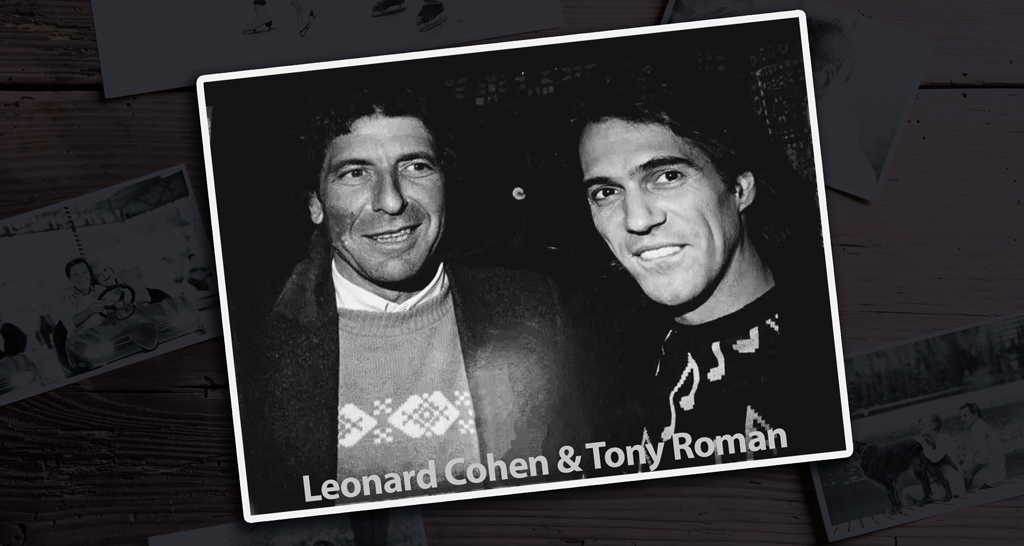
Toward the end of the 1990s, Tony formed a meaningful artistic relationship with his cousin Jon Manitouabe8ich (“Mucci”), also part of the D’Ambrosio lineage. Jon, a graphic designer, punk musician and writer, collaborated with Tony in his Old Montreal studio. Tony shared untold stories about his friendships with major Montreal cultural figures such as Bobby Di Salvio, Leonard Cohen, Pagliaro, and Robert Nickford, the latter becoming a long-time collaborator of Jon’s. Together, Tony and Jon developed artistic concepts, including a planned animated sequence for Tony’s film company—an idea ultimately set aside but emblematic of their creative synergy. Tony’s mentorship deeply influenced Jon in the creation of his band, Black Lizards.
Tony Roman stands today as far more than a local icon. He was a pioneer, a creator, a visionary producer whose influence transcended Quebec and reached into the international music and film scenes. His legacy continues to echo, shaping generations of artists and preserving his status as a timeless figure of artistic innovation.
Leave a Reply